
No one becomes attached to projects at the rate director Luca Guadagnino does. After two movies last year (“Challengers,” one of 2024’s very best, and “Queer”), the Italian director is back in theaters with “After the Hunt,” a flawed but compelling entrant in the Me Too conversation by way of academia.
“After the Hunt” debuted at this year’s Venice Film Festival, where it was received negatively, largely for not adding anything interesting to the Me Too discussion. It’s true; there are no deep revelations in “After the Hunt,” and a lot of the socially relevant conversations that are had feel like characters speechifying their way through real life topics, but with Julia Roberts, Andrew Garfield, Ayo Edebiri, and Michael Stuhlbarg heading those conversations, it’s hard to not be drawn into what the movie is offering.
Roberts plays Alma, a college professor who is on a track to tenure. One night she and her husband Frederik (Stuhlbarg) have a party with fellow academics at their home. The next day, Maggie (Edebiri), a Ph.D student and one of Alma’s star pupils, shows up at her door soaking wet from the constant rain happening throughout this movie. She’s clearly shaken but finally tells Alma that Hank (Garfield), Alma’s friend and fellow professor, sexually assaulted her. 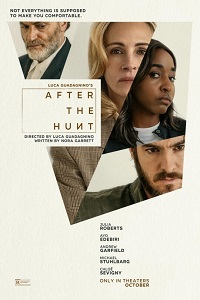
It doesn’t take long for Maggie’s allegations to take over the school, but Hank is hopeful Alma knows him as a friend well enough to support his claim of innocence. The driving force of “After the Hunt” is not the sometimes surface-level ramblings of the Me Too era, but Alma’s uncertainty about who to believe. Maggie looks to Alma as a mentor who can offer some support – though not as passionately as Maggie would have hoped – but Alma’s steely exterior rarely cracks. It’s often hard to know what Alma is thinking at a given moment.
“After the Hunt” was written by first time screenwriter and actress Nora Garrett, and a lot of it shows the hallmarks of a novice writer. The party scene that precedes Maggie’s allegation against Hank is a prime example of a new screenwriter grazing through important topics without digging too deep. There are times when the characters feel like they are given a checklist of topics to hit including power dynamics, gender, identity, and race. While it’s engaging to see the great cast playing off each other, these moments feel like they are structured with bullet-points.
The movie runs two hours and 20 minutes and occasionally spins its wheels (plot points involving Chloe Sevigny feels particuarly tacked on), but the actors are able to work through the screenplay’s flaws to deliver an engaging drama. Roberts isn’t at the forefront of movies as she once was, so to have a generational movie star sink into a nuanced role like Alma is always something worth watching. Garfield is effective at playing a pretty deplorable character who is dismissive of what eventually haunts him. There are moments when it might seem like he is playing Hank too big and broad, but the desire to yell at the screen when he speaks shows that Garfield’s performance is working. Edebiri, working in a different register than “The Bear” or “Bottoms,” demonstrates that she is capable of a variety of performances and projects and shouldn’t be typecast in comedies.
“After the Hunt” doesn’t have anything new or insightful to say about the Me Too movement, but it’s not really what the movie is after. “After the Hunt” works best as a morality tale, through the lens of Roberts’ character, who in her own way wants to protect Edebiri’s character and remain loyal to Garfield’s. It’s an imperfect movie in Guadagnino’s impressive and diverse filmography, but watching distinguished actors spar with each other is always a treat.
Leave a Reply