
<!– [if gte mso 9]><![endif]–>
Edgar Wright’s new adaptation of “The Running Man” is a sleek, adrenalized reboot that trades the camp of the 1987 cult classic for a grittier, more faithful take on Stephen King’s dystopian novella. It hits the ground running – almost too fast – with a pulse-pounding pace that rarely lets up. From the opening frames, Wright’s kinetic style is unmistakable: razor-sharp editing, stylized bursts of violence, and production design that conjures a convincingly bleak future ruled by corporate overlords and voyeuristic bloodsport. It’s a world where spectacle is currency and survival is entertainment.
World-building is one of the film’s most effective tools. Where the original confined itself to a crumbling corner of Los Angeles, Wright’s version sprawls across a fractured America: gritty slums in Co-Op Town, the sterile gleam of Network headquarters, and glimpses of New York, Boston, and Derry, Maine. These aren’t just locations; they’re ideological zones, each reinforcing the film’s vision of a society held together by fear, distraction, and cruelty. From the outset, it’s clear this is modernized ancient Rome, with fractured classes held in brittle equilibrium by brute force, pervasive surveillance, and the narcotic pull of sadistic entertainment. The film doesn’t just depict dystopia – it runs straight through it.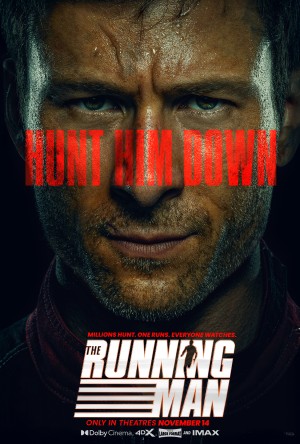
Glen Powell delivers a capable turn as Ben Richards, trading his usual charm for the rage of the disenfranchised. It’s a shift that works; he brings simmering intensity and even manages to inject moments of levity into this angrier incarnation. His Richards is less a reluctant hero than a man cornered by circumstance, and Powell plays that tension well. But while he anchors the film, the supporting cast is unevenly utilized.
Lee Pace, cast as the show’s top hunter, is a standout in theory. His physicality and charisma suggest a formidable foil to Richards, and he’s introduced with menace and flair (and “Fate” and “Destiny”). Yet the film never fully capitalizes on his presence. His arc is thin, his motivations undercooked, and his screen time surprisingly limited until the final act. It’s a missed opportunity to deepen the film’s central conflict; Pace could’ve run circles around the material if given more track.
Josh Brolin’s Dan Killian, the show’s producer, is written with cartoonish villainy that clashes with the film’s more grounded tone. He’s less a character than a blunt instrument for the film’s themes of corporate cruelty, media manipulation, and authoritarian spectacle. These ideas are timely, but delivered so plainly they lose their sting. In a world already saturated with dystopian headlines and reality-show absurdity, the message feels diluted. This is where the 1987 film arguably wins; Richard Dawson’s Damon Killian, both producer and host, chewed scenery with gleeful menace. Brolin’s version lacks that charisma, and it’s a real shame. He doesn’t run the show so much as stumble through it.
The soundtrack, typically a highlight in Wright’s work, is present but oddly subdued. There are flashes of his signature pop curation – needle drops emphasizing moments or injecting irony – but they’re deployed sparingly and with less impact than in “Baby Driver” or “Scott Pilgrim.” It feels like the music is there to check a box rather than elevate the narrative. That said, the use of Tom Jones’s “Keep on Running” over the closing credits is a cheeky touch, a rare moment where Wright’s playful instincts peek through the gloom.
More surprising – and perhaps more disappointing – is the absence of Wright’s signature tonal playfulness, even amid the copious violence. “Shaun of the Dead” by its very nature couldn’t avoid gore, but it still had heart and humor. “Hot Fuzz” sent up buddy cop tropes with gruesome flair and remains highly rewatchable. Wright’s best work dances between homage and subversion, finding joy in genre even as it deconstructs it. “The Running Man,” by contrast, is grim and often just plain angry. The humor feels sparse, the emotional beats simplistic and repetitive, and the film’s anarchic energy never quite coalesces into something memorable. It’s technically proficient but not particularly fun – and for Wright, that’s a strange outcome.
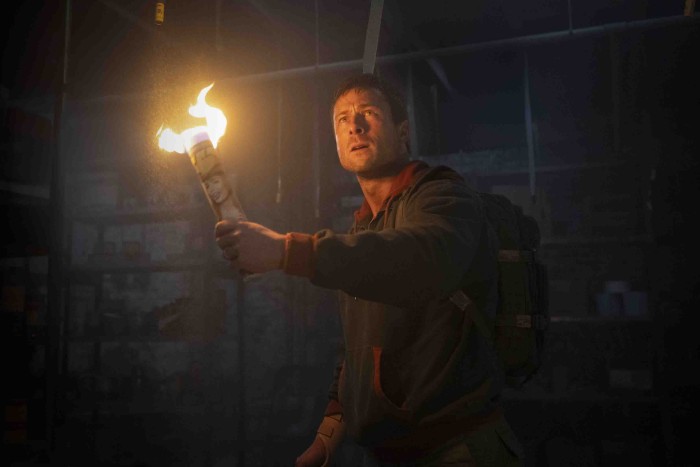
In the end, “The Running Man” is a well-crafted, well-intentioned reboot that runs hard but never quite finds its stride. It’s sleek, stylish, and thematically loaded, yet curiously hollow at its core. For all its momentum and visual polish, the film struggles to connect on a deeper emotional level. Wright delivers the spectacle, but not the spark. You leave the theater impressed by the machinery – the pacing, the production, the precision – but unmoved by any particular message. It’s a film that sprints through dystopia with confidence, but forgets to look back, breathe, or surprise.
Leave a Reply