
At first glance, writer/director Hikari’s new film “Rental Family” looks like it’s tracing the same path as “Lost in Translation”: a fish-out-of-water American actor adrift in Tokyo, quietly unraveling. But that comparison falls apart quickly; this isn’t a meditation on detachment or the kind of generational melancholy that defined Bob and Charlotte’s dynamic, with one looking back on his life already lived and the other unsure how to begin hers. Instead, “Rental Family” is about something more grounded: the basic human need for connection and attachment, set against a cultural backdrop where therapy – at least in its Western forms – still carries a quiet stigma.
Brendan Fraser (“The Whale”) plays Phillip, a washed-up American actor who stumbles into a job at a rental family agency, thinking it’s just another acting gig. And in the strictest sense, it is – but these actors are playing grieving loved ones, weeping over a “corpse” in a casket. This is a very real industry in Japan – people rent stand-ins for weddings, funerals, school interviews – and “Rental Family” uses that setup not for satire, but for something fascinating, strange, and achingly sincere. The crux of the film is Phillip’s journey through the moments when these fake relationships start to feel real – to him, and to his “scene partners” – and what it means to truly matter to someone, even temporarily. 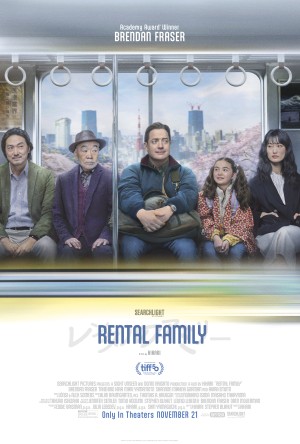
Continuing the #brennaissance with an exceptionally vulnerable and soulful performance, Fraser is both our guide through this unique working environment, and the film’s heart. Phillip exudes a kind of worn-down sincerity; funny, yes, but with pain lingering below the surface. He’s not entirely the fish-out-of-water you see at first glance, but he’s clearly lonely and untethered. Initially, he balks at the idea of taking regular rental family gigs and nearly tanks his first job. But he quickly realizes the warmth and light his performance can provide to his client, and soon takes on more challenging “roles.”
The film spends much of its time in a pair of these roles, one with aging actor Kikuo, and the other with a young girl named Mia. Kikuo’s daughter has hired Phillip to pretend to interview the elder man to add some variety to his life as his memory fades, while Mia’s mother needs the presence of a “father” during an entrance interview at a prestigious school to secure Mia’s placement. These two relationships are the film’s emotional core. It’s clear that while Phillip gives himself wholly to the “performance,” he is salving some unrevealed pain with each interaction. Each relationship is uniquely sketched: they’re often quiet, sometimes a little awkward, and completely believable.
The ensemble cast coalesces nicely, with each actor playing well off Fraser’s performance. Takehiro Hira (“Shogun”) plays Shinji Tada, the owner of the rental family agency, with confidence and persuasiveness as he recognizes the opportunity Phillip presents as his token white guy. But he balances that with warm encouragement and support as he nudges Phillip into the role. Mari Yamamoto (Pachinko) plays Aiko Nakajima, one of Phillip’s main peers at the agency, who’s struggling with her own identity and how she’s been typecast. “Rental Family” smartly avoids romantic entanglement between Aiko and Phillip, not for any lack of chemistry, but because there’s simply no room in this narrative for that subplot.
Akira Emoto, one of Japan’s most celebrated actors, delivers incredible richness in his performance as Kikuo Hasegawa. His interactions with Phillip’s journalist character unfold with precision and depth as Kikuo grapples with the reality of his stage of life. Lastly, newcomer Shannon Mahina Gorman makes her debut as the willful and spirited Mia, filled with uncertainty about this man suddenly appearing and claiming to be her father. Gorman and Fraser are convincing in their tentative and budding father-daughter relationship; it feels very natural. That said, the deeper ethical considerations of Phillip’s interactions with Mia and Kikuo (neither of whom are aware that he’s acting) are not fully explored, though the narrative doesn’t ignore their implications either.
Director Hikari keeps the film grounded throughout, with an almost documentary feel. She doesn’t exoticize the rental family concept or turn it into a punchline. Instead, she treats it as a symptom of something larger: how people cope with loneliness, and how they outsource care when real connection feels out of reach. The film doesn’t judge its characters for needing or providing these services; it simply invites us to watch as they try to make it work.
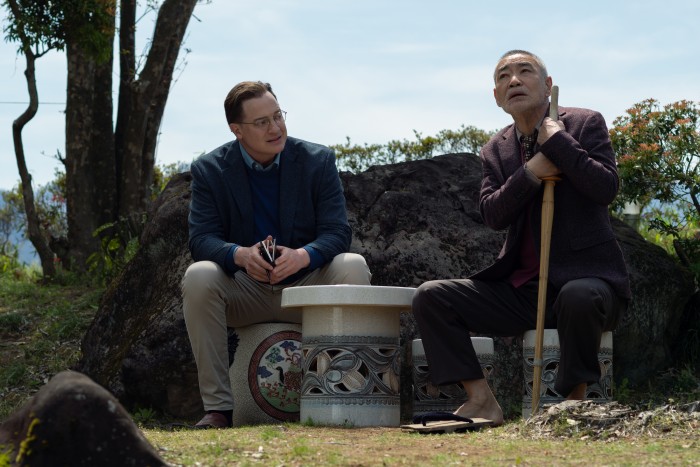
Takuro Ishizaka’s approach to filming Tokyo and Japan at large is natural and incredibly vibrant. I often found myself admiring the incredible detail and texture on display in both the cityscapes and countryside. Each frame contains beauty in multitudes.
Special credit is due to the careful scoring by Jónsi and Alex Somers. Given the topic, it’s unsurprising that emotion flows freely throughout the film. The music carefully rises and falls in just the right amounts to support, but not overwhelm, these delicate moments. I’m also never unhappy to hear “Glass, Concrete and Stone” by David Byrne make an appearance.
These times are desperate when it comes to human connection: we’re steeped in other-ism and anger, and we risk drowning out our ability to connect with each other. It is in this way that the simplicity of “Rental Family” makes its strongest value apparent. It is one hundred minutes of sincerity, vulnerability, and people simply being together. It doesn’t pretend that rented affection is the same as the real thing. But it also doesn’t dismiss the fundamental value of it. Sometimes, pretending is the only way people know how to ask for help. And sometimes, just showing up – even awkwardly, imperfectly, or for pay – is still infinitely better than not showing up at all.
Leave a Reply