
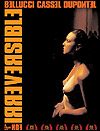
At first I thought about writing the review of Gaspar Noé's chronologically reverse film "Irréversible" backwards. Then I realized it wasn't worth the time to figure out how that would even be possible. Instead, the best I can do it try to give you back the two hours of your life that you might have spent watching Mr. Noé's trash heap. At its best, non-linear storytelling can be a freeing and revelatory technique for writers (see "Pulp Fiction", the TV Series "Boomtown" and of course "Memento"). At its worst it can be self-serving, masturbatory nonsense. Guess which category this film falls into.
There's no question that Mr. Noé has issues. Even the one tender love scene in the film ends in a spit fight. I suppose this film was the inevitable product of a director whose previous works have names like "Meat" and "Sodomites".
If I can give the film any credit at all, it is for its opening sequence which follows a man (Vincent Cassel) as he takes revenge against the man who raped his girlfriend. To throw the audience off balance in the film's bloody salvo, Mr. Noé uses a technique that is either a work of genius or incompetence. His camera seems to float like a feather on a breeze, spinning, climbing and finally descending into the homosexual "felching" club which serves as the location of the gruesome finale. The shot appears to be uncut. The music by Thomas Bangalter drones and pulsates as a constant strobe of red light illuminates only the barest details of location. Subtitles flash by as the hunt for the rapist continues. And when he is found, Mr. Noé lets his true colors and his true agenda show. Until this point, it seemed the director was going to tease the audience with vague imagery. But during the climactic orgy of gore, Mr. Noé lets the camera dwell over the proceeding, leaving nothing to the imagination.
Even more exploitative is the actual rape itself which, naturally, occurs after this scene of revenge. Suddenly, Mr. Noé's versatile camera is rooted to the ground for nine straight minutes as the victim (Monica Bellucci, Mr. Cassel's real-life wife) is brutalized by one of the most expository rapists in film history. Clearly writer-director Noé wanted to be sure the audience knew exactly what Bellucci's character was going through in no uncertain terms. Worse still, by telling the story in reverse, the audience knows that Ms. Bellucci is not only raped but also put in a coma. This knowledge leaves the audience with the dread of knowing exactly what they must sit through in the hands of the sadistic director.
In "Memento", writer-director Christopher Nolan had to tell his story in five-minute increments due to his hero's malady. In "Irréversible", Mr. Noé breaks up the story at a whim for the greatest shock-value. Unlike Mr. Nolan, Mr. Noé has no story to tell. Told in chronological order "Irréversible" would feel exactly the same as it does: pretentious, manipulative and dull. Obviously, Mr. Noé wanted to see how far he could push the envelope. The rest of the film – the ham-handed love triangle, the pseudo-intellectual discussions of portents and precognition – is all filler.
Ostensibly, the theme of the film is "time destroys everything". Ironically, the only thing "Irréversible" succeeds at is destroying 2 hours of your life. Inadvertently, the only true message that Mr. Noé succeeds in making is that the beautiful Monica Bellucci, like her character in the film, deservers better. The most telling difference between this film and "Memento" is that where Mr. Nolan's film inspired conversation long after it was over, with "Irréversible" all you'll want to do is forget you ever saw it.
Leave a Reply